An arcade name reaches the television
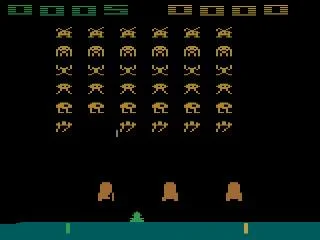
Taito’s arcade game first appeared in Japan in 1978; Atari’s licensed 2600 version followed in 1980. The Strong describes the home conversion as an important reason to buy the console. Its different formation and numerous variations deserve attention in their own right, rather than being treated as evidence that the two machines ran the same game program.
A formation that will not wait
The formation is both a target and a shrinking deadline. Removing aliens makes the remaining group faster, so an apparently successful wave can end with an awkward final chase. Shields provide breathing room until shots wear holes through them. The home version’s variations change those familiar relationships with moving shields, different bombs and two-player arrangements. They make a single cartridge useful for more than repeating one arcade rule set.
Begin with the ordinary one-player game and watch how clearing a column changes the threat. Try a two-player variation once the basic rhythm is familiar. The game-select and difficulty switches are part of the original interface; a compilation or emulator needs to expose them for those options to remain usable.
Why we chose it for Atari 2600
Compare a licensed arcade attraction with the variations and controls of its separately dated home conversion.
Explore this console’s game selection ↗Release record
Original worldwide release: 1978. Release records above identify the console editions covered by this collection.
Sources and further reading3 references
- Space Invaders ↗The Strong National Museum of Play · Accessed 2026-10-27
Museum history separates the 1978 Taito arcade game from the 1980 Atari home conversion.
- 'Space Invaders' for the Atari 2600, Game Packaging ↗Science Museum Group · Accessed 2026-10-27
US Atari packaging dated 1980. No claim of image reuse is made.
- Space Invaders — Atari Game Program Instructions ↗Atari / AtariAge · Accessed 2026-10-27
Primary manual accessed through an archive transcription; describes the joystick controls and home variations.