Aim where the danger is going
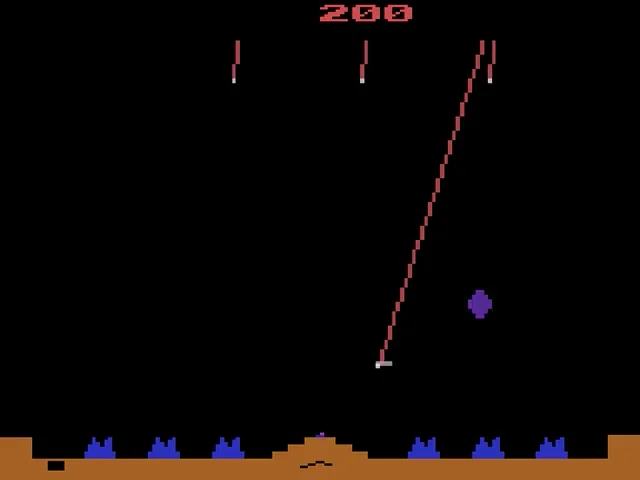
Aiming at the missile’s present position is often too late. You need to put an explosion where the threat will be, then move the cursor to another part of the sky. Several missiles can enter one blast, making a patient shot more valuable than frantic firing. Limited ammunition turns that judgement into a cost. The cities below keep the consequences visible even when the cursor is busy elsewhere.
Try placing a few early explosions high enough to intercept several paths. Resist spending the full ammunition supply on a threat that is already moving into a blast. A standard joystick is sufficient for the original cartridge; arcade trackball footage describes a different control arrangement.
One base and a joystick
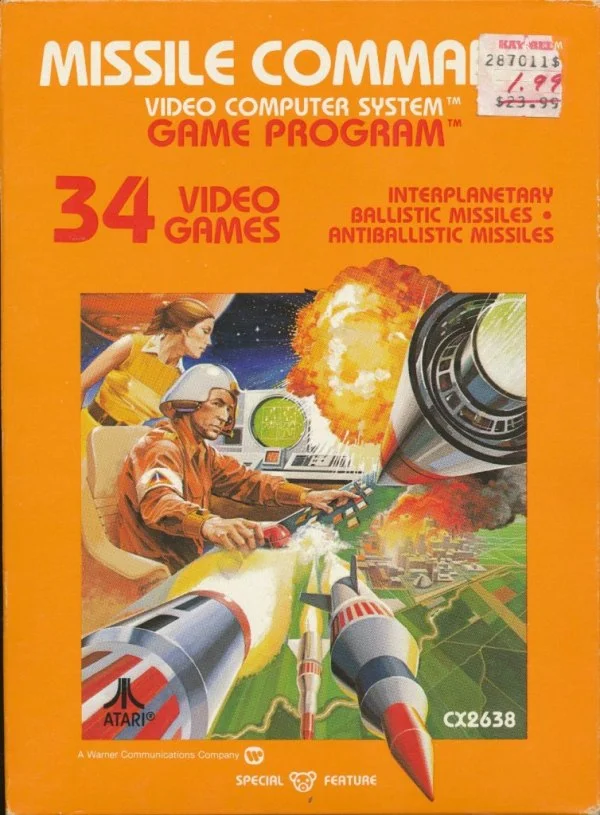
The arcade Missile Command dates to 1980; the 2600 conversion is recorded in 1981. The home version uses a joystick and one central missile base, changing the physical decisions of the arcade’s trackball and three firing buttons. Atari’s current reproduced-instructions page uses a 1980 release heading, so the platform year here follows the 1981 catalogue and the Centre for Computing History’s edition record.
Why we chose it for Atari 2600
Delayed explosions and scarce ammunition produce a clear, demanding exercise in anticipation.
Explore this console’s game selection ↗Release record
Original worldwide release: 1980. Release records above identify the console editions covered by this collection.
Sources and further reading3 references
- Missile Command ↗Centre for Computing History · Accessed 2026-10-27
Museum record separates the 1980 arcade debut from the 1981 Atari 2600 conversion.
- Missilecommand ↗Atari · Accessed 2026-10-27
Reproduced home-game instructions. Its 1980 Original Release heading is not treated as the 2600 conversion date; see the 1981 catalogue and museum record.
- Atari 2600 Catalog — Atari (CO16725-Rev. B) ↗Atari / AtariAge · Accessed 2026-10-27
1981 manufacturer catalogue with archive index; lists Asteroids and Missile Command. Does not establish a precise retail day.