Leave yourself an exit
The useful question is where you will stand after placing a bomb. A promising trap can close your own exit, while a chain reaction can shorten the time you thought remained. The rules are easy to watch and hard to keep entirely under control. Human opponents make the board especially lively because they can spot the same escape route and decide to block it.
A small local match is enough to learn the timing; ten players are not a prerequisite for enjoying it. Keep the initial rules simple and add complications after everyone has had a chance to understand the blast pattern. The single-player mode offers a different pace between matches.
Making room for ten
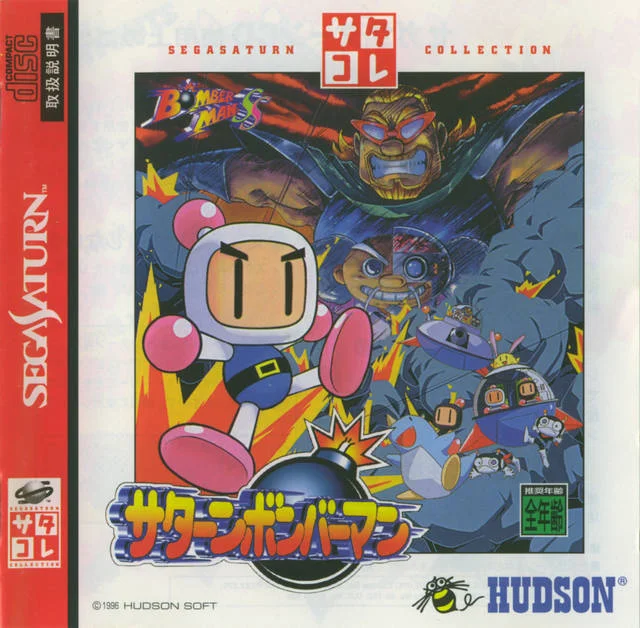
The Japanese Saturn game appeared in 1996. Its original manual documents a battle mode for up to ten people with the necessary adapters, alongside a separate normal game. The larger gathering is a hardware arrangement to plan, not something the console’s two front ports can deliver unaided.
Why we chose it for Saturn
A shared screen makes every bomb a public decision. A small group is enough to discover the appeal.
Explore this console’s game selection ↗Release record
Original worldwide release: 1996. Release records above identify the console editions covered by this collection.
Sources and further reading2 references
- ソフトウェア一覧(ソフトライセンシー発売) ↗Sega · Accessed 2026-10-27
Japanese Saturn Bomberman (1996), Tomb Raiders (1997) and Radiant Silvergun (1998) records. The calendar describes these Japanese editions, not their first worldwide releases.
- Saturn Bomberman — Instruction Manual ↗Hudson Soft / Sega; scan preserved by Sega Retro · Accessed 2026-10-27
Original US manual: controls, normal/battle modes and up to ten players with two six-player adapters. Used as documentation; no page images are reproduced.